


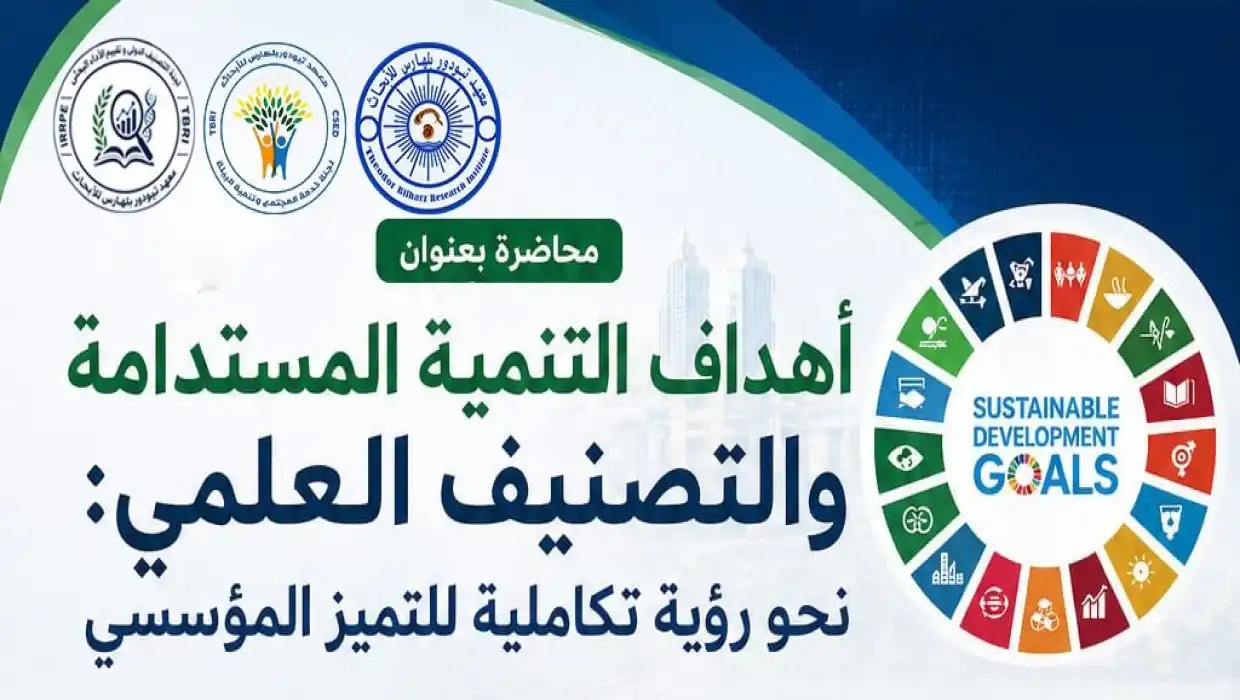
TBRI aligns with national trends by holding a specialized workshop on research evaluation and institutional planning in support of the sustainable development strategy.
As part of Theodor Bilharz Research Institute's leading role in supporting the scientific research system, enhancing institutional performance, and promoting alignment with national and international sustainable development goals, the Institute organized a specialized workshop on the current status of international rankings and program and performance budgeting indicators. The workshop was held under the auspices of Professor Dr. Ahmed Abdel Aziz, Director of Theodor Bilharz Research Institute and Chairman of the Board, and with the participation of a select group of experts and specialists in research evaluation and strategic management.
The workshop included two scientific lectures addressing interconnected themes aimed at improving the efficiency of institutional planning, maximizing the benefits of scientific research outputs, and strengthening the link between research performance, international indicators, and the requirements of sustainable development. This contributes to supporting decision-making and improving performance efficiency within research institutions.
The first lecture, titled "Analysis of the International Ranking Indicators of Theodor Bilharz Research Institute in the SCIMAGO Ranking," was presented by Mr. Yasser Abdel Fattah Salem, Director General of Administrative Affairs at the Petroleum Research Institute. He reviewed the general framework of the Egyptian government's work program, focusing on the pillar of developing and enhancing the well-being of Egyptian citizens, and the role of scientific research in supporting this direction, in line with the mission and strategic objectives of Theodor Bilharz Research Institute.
The presentation also addressed the analysis of research, development, innovation, and societal impact indicators, according to the new methodology of international rankings. It presented input and output indicators, the number of researchers, the quality of scientific publications, innovation indicators, and patents. This was done within the framework of reviewing the current ranking of Theodor Bilharz Research Institute in the latest SCImago ranking for the Middle East and North Africa, which included the institute's research and innovation performance from 2020 to 2024. The presentation also reviewed practical methodologies for interpreting international ranking indicators and mechanisms for utilizing statistical data and transforming it into analytical tools that support the objective evaluation of research performance within the institute. This reflects the institute's efforts to improve its standards and enhance its competitiveness at both the regional and international levels.
The second lecture, titled "Performance Indicators for Program and Performance Budgeting in Light of the Sustainable Development Strategy," was presented by Dr. Mohamed Maher Abdel-Tawab, Director General of Research Evaluation and International Ranking at the Ministry of Higher Education and Scientific Research. He addressed the general framework of sustainable development and the United Nations Sustainable Development Goals, their relationship to Egypt's Vision 2030, and the modern approaches included in the Unified Public Finance Law aimed at enhancing the efficiency of public spending and linking the budget to objectives and results.
The lecture reviewed program and performance budgeting as one of the most important modern tools in the financial planning of research institutions. It explained the stages of budget preparation within research entities, the main features of this system, and its advantages related to performance measurement, improving resource allocation efficiency, and enhancing governance and transparency. The lecture also addressed the challenges and difficulties facing its practical application, mechanisms for dealing with them in accordance with the nature and activities of research institutes, and how to monitor, calculate, and utilize quantitative and qualitative indicators for continuous evaluation and adjustment. This ensures maximizing the benefits of implementing program and performance budgeting and supporting the achievement of the strategic objectives of Theodor Bilharz Research Institute.
Following the two lectures, a practical workshop was held, providing participants with an opportunity to apply the concepts and indicators presented. The aim was to maximize the benefit and transform the theoretical framework into applicable, actionable tools, thereby contributing to improved planning efficiency, monitoring of quantitative and qualitative indicators, and their alignment with the institute's strategic objectives and research programs.
In this context, Dr. Ahmed Abdel Aziz, the institute's director, emphasized that this workshop represents a pivotal step in the institute's institutional development. He noted that a conscious approach to international rankings and performance indicators is no longer optional, but rather a strategic necessity to ensure the sustainability of research excellence and maximize the developmental impact of scientific research. He explained that the institute operates according to a clear vision that aims to align research performance with the priorities of the Egyptian state and the Sustainable Development Goals, and to link the outputs of scientific research to the needs of society and industry. This enhances the added value of scientific research and ensures the efficient and effective utilization of resources.
He added that adopting program and performance budgeting methodologies reflects the state's commitment to enhancing transparency and measuring the true impact of public spending. He emphasized the institute's dedication to building the capacity of its human resources and equipping them with modern analytical and planning tools, which will contribute to improving the institute's ranking in international indicators and classifications, and solidifying its position as a leading research institution at both the regional and international levels.
This workshop is organized within the framework of Theodor Bilharz Research Institute's strategy aimed at developing the scientific research system, raising the efficiency of institutional performance, and strengthening the integration between financial planning and research evaluation. This supports the state's goals of building a knowledge-based and innovation-driven economy. Through these events, the institute reaffirms its ongoing commitment to implementing international best practices, investing in human resources, and maximizing the impact of scientific research, thereby contributing to achieving sustainable development and consolidating the institute's role as one of the national research institutions supporting progress and development in Egypt.
Recent News
Meta
- TBRI aligns with national trends by holding a specialized workshop on research evaluation and institutional planning in support of the sustainable development strategy.